The philosophy behind this book
From the Foreword.
Why
When both stones of a grinding mill move, nothing can be ground effectively. For the grinding to happen, one stone must remain firm and steady, while the other rotates against it. That is the philosophy behind this book. Trying to learn Financial Mathematics and Agentic AI at the same time can make the learning process unnecessarily difficult — it is moving both stones at once. We keep Financial Mathematics as the strong, stable foundation, and let Agentic AI be the rotating stone that moves across it.
Who it's for
Written for a reader who knows some Financial Mathematics — interest theory at the level of a first actuarial or finance course — and can write and run short Python programs. No experience with language models or agent frameworks is assumed.
How it's built
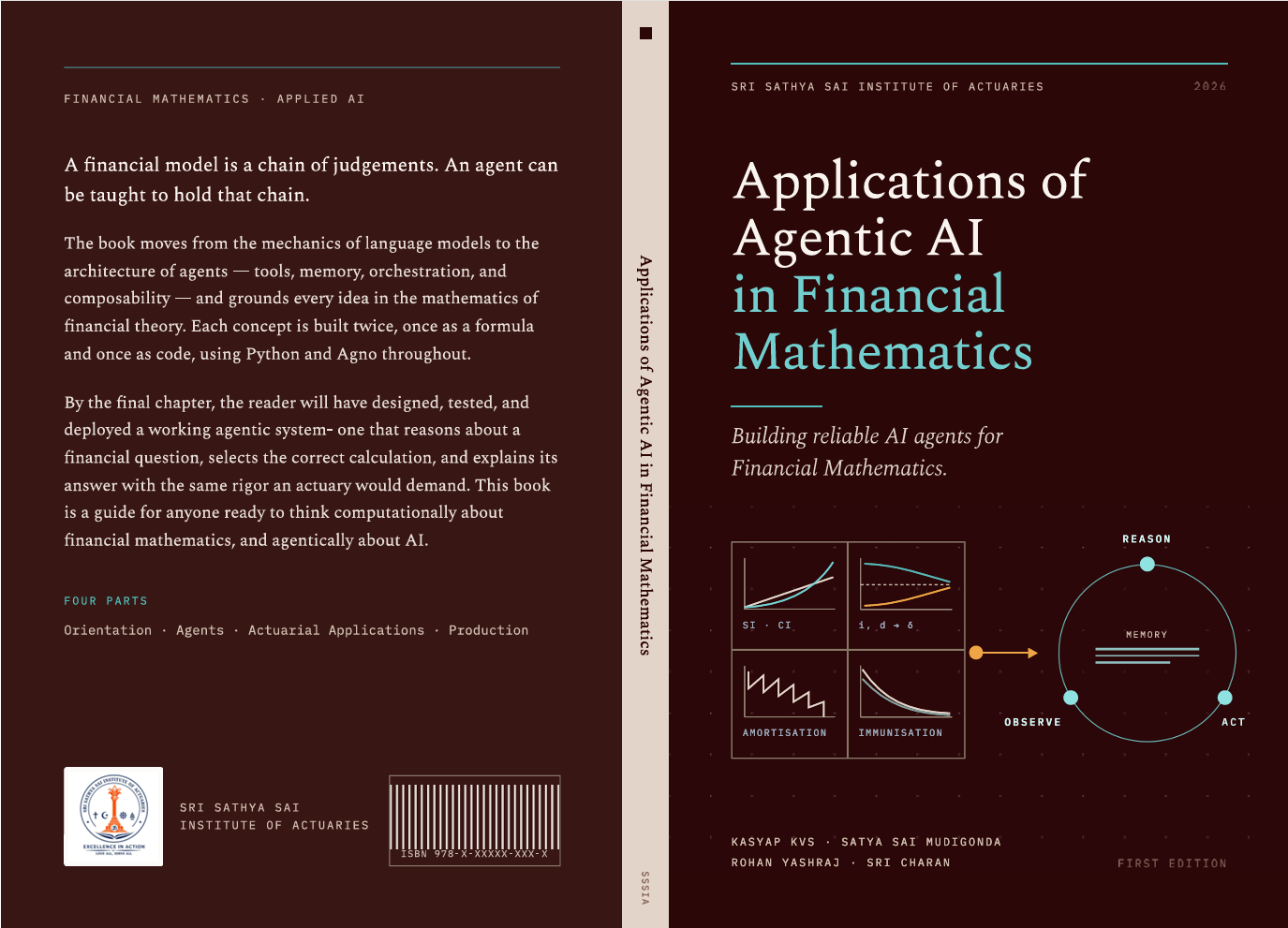
Part I builds the minimum conceptual foundation needed before anything else makes sense — what a language model actually does. Part II introduces the vocabulary and mechanics of agentic systems using general-purpose examples, before any Financial Mathematics is involved: memory, tools, reliable configuration, composability through MCP, and multi-agent systems. Part III is the core of the book — across nine chapters, each one carries a Financial Mathematics topic from formula to a working Agno agent: concept, mathematics, worked examples, Python implementation, agentic application, and where the approach can fail. Part IV addresses what changes when an agentic application moves from a notebook experiment to something intended for real use — architecture, evaluation, guardrails, and observability.
Explore the book
Four parts, twenty-one chapters. Pick a part to see its chapters.
Orientation
Why the subject matters, and what a language model actually does.
2 chaptersAgents
The vocabulary and mechanics of agentic systems, built with general-purpose examples before any Financial Mathematics is involved.
6 chaptersActuarial Applications
The core of the book: nine SOA Exam FM topics, each carried from formula to a working Agno agent.
9 chaptersProduction
What changes when an agentic application moves from a notebook experiment to something built to be relied on.
4 chapters